
I build and rigorously stress-test specialized, full-stack deep learning solutions for complex domains like medical imaging and climate modeling.

ARIA Pipeline Designed a neuro-symbolic pipeline for automated radiology report generation, achieving a 0.718 GREEN score and reducing hallucination by 66.2% vs. baselines. [?]GREEN: a framework that evaluates clinical correctness, factuality, and coherence of generated medical text via a critic LLM.
BLISSNet Implemented a DeepONet-style neural operator for spatiotemporal climate data super-resolution, identifying strict cross-region degradation tied to SIREN trunk coordinate dependence. [?]SIREN: a neural network that uses periodic activation functions (sinusoids) to learn high-frequency details and coordinate mappings.
Daniyal Hussain Shah - Professional Portrait

Open for AI/ML engineering roles and research collaborations - reach out via email at daniyalhussain296@gmail.com or on LinkedIn.

Selected Work

Two research projects in medical imaging and climate modeling, currently ongoing.

ARIA - Neuro-Symbolic Guardrails for Brain MRI Report Generation Medical AI
Automated radiology reporting with grounded generation
This research is ongoing; the results below reflect current progress.

The Problem

Standard Vision-Language Models (LLaVA, MedGemma, Qwen-VL) produce fluent but clinically untrustworthy radiology reports. In neuro-oncology, misidentifying tumor grade or overlooking ependymal contact alters surgical pathways - a catastrophic failure mode standard end-to-end VLMs cannot prevent.

What I Did & Decided

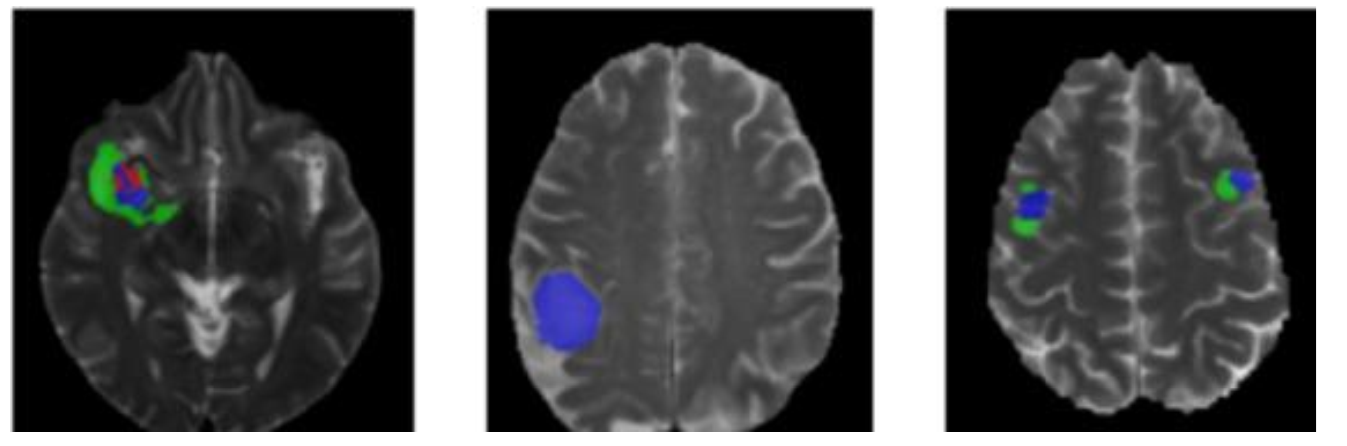
Engineered ARIA, a neuro-symbolic pipeline that decouples visual extraction from language generation. SegResNet segments mpMRI into sub-regions, extracted radiomic features populate a diagnostic knowledge graph derived from official grading standards, and an LLM writes the report strictly grounded on graph attributes rather than unconstrained pixel tokens.

What Came of It (So Far)

Evaluated on 1,251 patients, segmentation reached Dice scores of WT: 0.757 [?]Whole Tumor TC: 0.428 [?]Tumor Core ET: 0.354 [?]Enhancing Tumor Upstream mask noise proved to directly alter downstream focality classification. The knowledge graph provided necessary grounding: generation scored GREEN: 0.718 while removing the graph caused hallucination rates to spike up to 0.63 across tested models.
BLISSNet - Diagnosing Spatial Generalization Failure in Neural Operators Climate AI
Neural operator super-resolution on ERA5 reanalysis data
This research is ongoing; the results below reflect current progress.

The Problem

Reconstructing continuous physical fields from arbitrary, variable-count sparse sensors without retraining per grid or pre-interpolating inputs is unresolved in practice. DeepONet-style neural operators promise continuous domain-independence, but BLISSNet was only demonstrated on synthetic Navier-Stokes and quasi-geostrophic flows. Its capability on real ERA5 climate data and cross-region transfer remained unvalidated.

What I Did & Decided

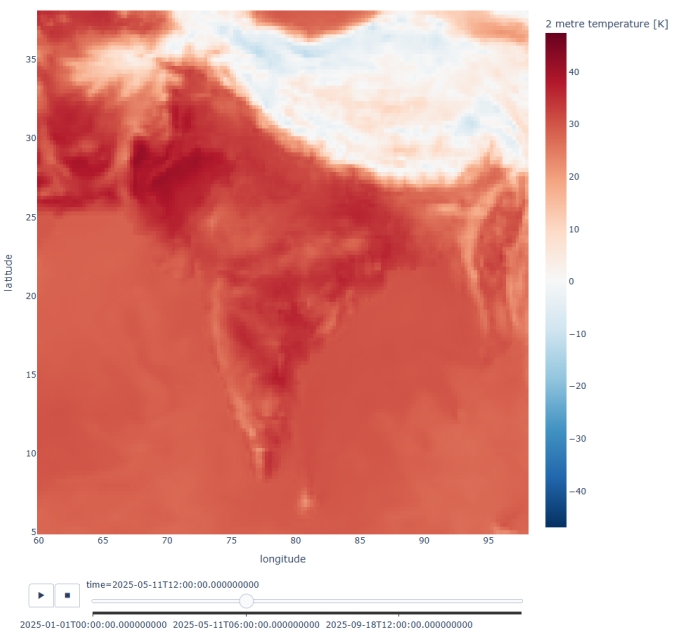
Re-implemented the architecture from the paper in PyTorch and engineered an automated ERA5 pipeline handling GRIB ingestion, spatial resampling, regional slicing, and NetCDF export. Built three region-specific models (South Asia, Punjab, Karnataka) on 2m temperature as single-snapshot runs, intentionally isolating spatial generalization as the sole variable under test.

Train \ Test South Asia Punjab Karnataka
South Asia 0.96RMSE: 0.9K -0.42RMSE: 24.5K -0.58RMSE: 27.3K
Punjab -0.31RMSE: 21.8K 0.91RMSE: 1.6K -0.73RMSE: 31.2K
Karnataka -0.49RMSE: 25.9K -0.37RMSE: 22.4K 0.82RMSE: 2.3K

What Came of It (So Far)

In-domain reconstruction was solid - R²: 82–96% RMSE: 0.9–2.3K - but cross-region transfer collapsed to R² ≤ 0% across all 6 out-of-domain pairings RMSE: 20–36K. Global [-1, 1] coordinate normalization failed to resolve the failure. Root cause traced to the SIREN trunk: the network memorizes absolute geographic coordinates rather than underlying physical dynamics.

Open for AI/ML engineering roles and research collaborations - reach out via email at daniyalhussain296@gmail.com or on LinkedIn.

About Me

I am a rising junior at LUMS, pursuing a B.S. in Computer Science (A.I. Specialization) and a Minor in Robotics.

My primary focus lies in AI research, specifically developing novel architectures to solve complex state-of-the-art problems. I rigorously evaluate where continuous and multimodal architectures fail when moved from benchmark papers to messy physical domains, as demonstrated in my work with ARIA and spatiotemporal super-resolution.

Originally from Kahror Pakka, Punjab, and currently based in Lahore, I am also actively exploring and studying the applied AI industry and Agentic AI.

Download CV (PDF)

Open for AI/ML engineering roles and research collaborations - reach out via email at daniyalhussain296@gmail.com or on LinkedIn.

Send a Message

Contact

Always one message away. Reach out for collaborations, research discussions, or engineering opportunities.

Open for AI/ML engineering roles and research collaborations - reach out via email at daniyalhussain296@gmail.com or on LinkedIn.